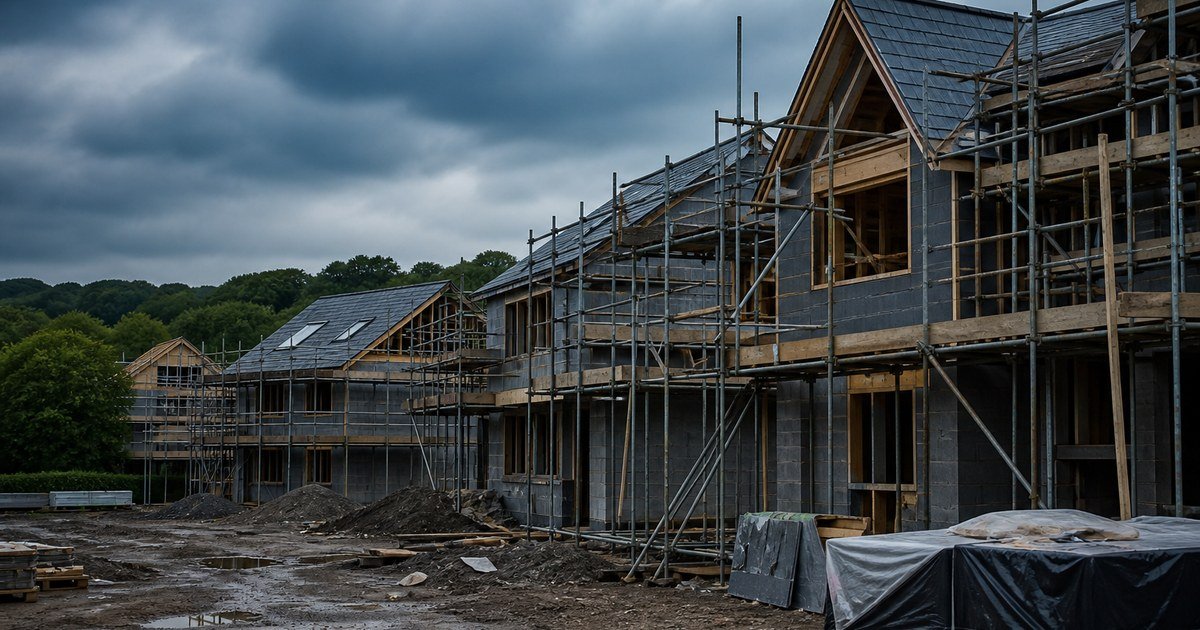
The cashflow still shows private sales from month nine. Credit has crossed that line out. Housebuilding activity printed 37.6 on the August Construction PMI, a sharper fall than July’s 41.8 and the weak link inside a headline that slipped to 44.3. The Intermediary’s same-day write-up of the S&P Global release put residential work as the main drag. Mortgage Strategy carried the same pack. For a professional borrower on development finance, that sub-index matters more than the 0.4-point headline move.
When a residential sales schedule assumes July’s rebound still holds
July’s Construction PMI rebound from 38.4 to 44.7 gave some sponsors a softer line to argue. Our July PMI note covered that stabilisation signal in detail. Activity was still contracting. The pace of decline had slowed. Housebuilding at 41.8 was the least severe residential fall since October 2025.
August unwinds that comfort. The sector did not tip back into expansion. It lost the ground the July print had suggested was returning. Sponsors who left optimistic private-treaty absorption rates in the model now face a survey that says residential workloads fell harder again.
That is a credit problem before it is a macro story. Development facilities repay from sales receipts or a refinance onto investment debt. Soft housebuilding activity hits the first path first. Marketing periods stretch. Asking prices that assumed a late-summer recovery look thin. Interest burns while the exit waits.
Brokers sometimes leave the July pack untouched and add a covering email. That does not help. Credit opens the cashflow, not the covering note. If month-nine sales still assume the softer 41.8 residential print, the file is already behind the survey.
Keep the original cashflow in the pack if you must. Put the re-cut beside it. Show what peak debt and interest reserve look like if sales land two or three months later at a 5% softer price. Files that only work on the July rebound narrative will not clear a fresh committee.
What the August Construction PMI actually printed
The Intermediary reported the seasonally adjusted S&P Global UK Construction Purchasing Managers’ Index at 44.3 in August, down from 44.7 in July. The reading stayed below the neutral 50 mark for a twentieth successive month. Mortgage Strategy confirmed the same headline and the residential lead.
The sub-sector split is the useful part of the pack.
- Residential work printed 37.6, a sharper downturn than elsewhere in the sector.
- Commercial construction stood at 47.8.
- Civil engineering registered 40.5.
New orders fell, but at the slowest rate since September 2025. Employment declined again, though the job loss pace was the smallest since February. Subcontractor use rose for the first time in almost two years. Input price inflation eased to a six-month low even while firms still reported higher fuel, transport and raw material costs.
Tim Moore at S&P Global said a faster downturn in house building was the main reason for the weaker overall August performance. A sharp drop in residential activity more than offset slower falls in commercial and civil work. He also flagged sluggish demand, low client confidence and anxiety about the Middle East conflict as recurring workload drags.
Reuters’ wire on the same morning put the print against a poll that had expected 45.5. The miss matters less than the direction. July’s recovery narrative needed another soft-decline month to hold. August did not deliver it.
Why housebuilding at 37.6 bites harder than the headline 44.3
A headline move from 44.7 to 44.3 looks small on a chart. Residential at 37.6 does not. That is deep contraction territory for the segment that fills most residential-led GDV models.
Sale exits feel it first. Private buyers still need mortgage capacity. July’s Bank of England approvals print was already soft. Our combined note on July mortgage approvals and Nationwide’s August prices sits beside this PMI. Soft approvals plus a harder housebuilding downturn is a poor backdrop for aggressive off-plan or early private-treaty assumptions.
Refinance exits feel it second. Investment debt on completed residential stock still needs rental cover and a valuer who will meet the number. Thin sales evidence in the local market can pull the valuation. A weaker GDV cuts the advance and leaves a hole in the peak-debt plan.
Land and start decisions lag the survey. Our Q2 housebuilder land values note already showed greenfield prices down and reservations soft. An August residential PMI at 37.6 argues against treating land as a quick flip into a hot sales market. Sponsors buying sites on a short facility still need a named build loan or a sale exit with honest timing.
The British Chambers of Commerce Q3 forecast, covered in our 2 September industry note, still puts UK construction down 1.3% for the full year. August’s PMI does not contradict that annual shrink. It weakens the case that July alone marked a durable turn.
Commercial and civil prints still leave speculative exits selective
Commercial construction at 47.8 is the least weak segment in the August pack. It is still below 50. That means more firms reported a fall in commercial activity than a rise. Credit should not read 47.8 as permission for high gearing on secondary stock.
Mixed-use and commercial-led schemes still need tenant evidence, current rents and a refinance path that clears today’s curve. Yesterday’s gilt spike note covered ten-year yields near 5.25% and the 30-year near 5.89%. Term debt prices off that curve more than off Bank Rate. A commercial PMI that is less weak than housebuilding does not reopen cheap take-out finance.
Civil engineering at 40.5 remains soft. Most StatusKWO residential and commercial development files do not turn on civil workloads. Shared supply chains still matter. Materials, plant and subcontractor diaries move with the wider sector. A soft civil print can free labour for building work. It does not create buyers for finished flats.
Pockets of vitality still appear in survey comments. Transport infrastructure, data centre roll-outs and energy projects showed some support for new business. Those pockets rarely rescue a local residential scheme that depends on private buyers clearing units at the modelled price. Package the security in front of you, not the national anecdote.
Sponsors with a commercial element inside a mixed scheme should still separate the income story from the residential sales story. A let ground-floor unit with evidence does not rescue upper-floor flats that need mortgage-backed buyers. Credit will split the exit. So should the pack.
Costs, orders and gilt pressure on the same credit pack
Input price inflation easing to a six-month low is welcome after the spring spike. It is not a reason to strip contingency. Firms still reported upward pressure from fuel, logistics and raw materials. Cooler average cost growth can coexist with volatile individual packages.
New orders falling at the slowest pace since September 2025 is the other soft positive. Tender flow is less bad than it was. It is not strong. Employment is still falling. Confidence remains subdued against elevated borrowing costs and geopolitical risk.
Richard Pike at Phoebus Software, quoted in both trade write-ups, tied the print to gilt yields at their highest since 1998 and climbing oil prices. That is the same funding backdrop our gilt note covered for bridging refinance exits. On a development file the link is direct. Higher term rates raise the cost of the take-out. Higher build and funding costs raise the equity needed to keep interest cover honest through the programme.
StatusKWO’s published commercial terms currently show a monthly rate from 1.25%, an entry fee of 2%, an exit fee of 1.5% and a maximum LTV of 85%, with loan sizes from £10,000 to £10,000,000+ and terms of up to 16 months. Those figures are product terms. Soft residential activity and a higher gilt floor still push haircuts on optimistic GDVs and thin equity.
Bank Rate remains 3.75% ahead of the 17 September MPC. A held policy rate does not repair a sales schedule that assumed July’s softer residential decline would stick. Stress the exit at today’s PMI, today’s curve and today’s local comps.
Bridging versus development lines when starts stay soft
Bridging loans and development facilities solve different clocks. A bridge suits time-critical acquisition, light to heavy works and professional purchases where the exit sits inside months. Development finance suits ground-up and heavier schemes with staged drawdowns against certified works. Our comparison of development finance versus bridging loans still sets the product split.
Soft starts tempt some sponsors to secure land on a short bridge while planning or procurement finishes. That only works with a named next facility and enough equity to absorb delay. Treating the bridge as a cheap substitute for a full development line is a common failure mode. Interest accrues daily. The site waits. Underwriters will ask for the build programme, contractor status and the refinance or sale path before they treat the facility as temporary.
Auction finance stays a completion tool on a fixed clock. A soft PMI does not extend 28 days. Professional buyers still need certainty of funds before the hammer. Portfolio finance can help sponsors recycle equity across several assets while one scheme waits for a cleaner start window. Cross-collateral still needs honest valuations on every security, including the quiet ones.
We lend on an unregulated commercial basis to professional investors, developers and corporate borrowers. Owner-occupier main-home lending is outside the product set. The August PMI still shapes how those commercial facilities are sized because it shapes delivery risk, sale liquidity and the cost of term exits.
Distressed or delayed sites can still create purchase opportunities for capitalised buyers. Buying someone else’s stalled programme without contingency, contractor cover and a realistic GDV is not a strategy. Soft PMI months produce thin pipelines. They also produce files that need more equity than the vendor will admit.
What to re-cut before the September MPC
- Re-run sales rates and GDV against current local comps, not the July rebound narrative.
- Keep build contingency funded even though input price inflation eased to a six-month low.
- Separate bridging from development use cases. A land bridge still needs a named build loan or sale exit.
- Stress refinance quotes at today’s gilt and swap levels, not at spring term sheets.
- Evidence planning status, contractor quotes and programme dates. Soft sector starts do not excuse thin packs.
- Use portfolio equity carefully if one scheme is delayed. Value weaker assets honestly before cross-charging them.
Do the re-cut before the broker call, not after the first decline. Committees move faster when the pack already answers the residential 37.6 print.
A Decision in Principle helps brokers package speed without pretending the exit is guaranteed. StatusKWO’s decision in principle engine is built for that professional workflow. Bring the security address, loan amount, term and exit route. Soft construction prints raise the bar on evidence. They do not cancel every viable scheme with equity, a contractor and a named take-out.
Frequently asked questions
Does an August PMI of 44.3 mean construction is growing again?
No. Readings below 50 still signal contraction. August’s 44.3 print is a twentieth successive month below the line and a step back from July’s 44.7.
Why does the residential 37.6 print matter more for development finance?
Most residential-led schemes repay from private sales or a refinance that depends on local residential evidence. A deep housebuilding downturn stretches marketing periods, pulls valuations and raises the equity needed to keep peak debt honest.
Is cooler input cost inflation enough to cut contingency?
No. Inflation eased to a six-month low, but firms still reported higher fuel, transport and raw material costs. Contingency should follow live package quotes, not one survey month.
When is a bridging loan the better tool than development finance?
Use a bridge for a short, named clock such as acquisition, light works or auction completion. Use development finance for staged ground-up or heavy works. Soft PMI data does not turn a bridge into a build loan.
How should brokers package a live scheme after this release?
Show a re-cut cashflow with slower sales and today’s refinance quotes. Attach current contractor prices, planning evidence and a named exit. Start with the decision in principle engine if you need a documented professional starting point.