Sixty-one percent. That is the share of listed homes Rightmove says find a buyer this year. The September asking-price print rose 0.7%. Credit still reads the sell-through rate before it celebrates the rebound.
Rightmove’s September 2026 House Price Index, released on 21 September, puts newly listed asking prices up £2,441 to £367,440. It is the first monthly lift since May and above the ten-year September average of 0.5%. Prices remain 0.8% below last September and 2.3% below the start of summer. Homes for sale sit at a twelve-year high for the time of year. Buyer enquiries and agreed sales are each 9% lower than a year earlier.
We price short commercial facilities for professional investors, developers and corporate SPVs. Owner-occupier main-home borrowing is outside that book. Published terms currently start at a monthly rate of 1.25%, with a 2% entry fee, a 1.5% exit fee, LTV up to 85%, advances from £10,000 to £10,000,000+ and terms up to 16 months. A seasonal ask rebound does not move those figures on its own. A thin sell-through rate does.
The 0.7 percent ask that still leaves a slow sale clock
A higher new-listing average is not a cleared bridging loan exit. It is a marketing pitch from fresh sellers. The desk still needs days on market, the cut trail and a Plan B that can redeem the facility if the private-treaty clock slips.
Our August Rightmove note covered a 2.0% monthly fall to £364,999. September recovers part of that cut. It does not rewind the summer. Rightmove itself calls the rise a modest recovery rather than a turning point. The Intermediary’s write-up and Housing Today’s same-day report repeat that framing. Trade press confirms the tables. It does not replace them.
National time to find a buyer sits at 64 days. A further 150 days then sit between that offer and completion on Rightmove’s own clock. A ninety-day sale memo written against a 0.7% rebound still looks thin when the asset has already been live for a quarter. Thursday’s sale-exit evidence pack is the checklist. Today’s print is the market reason credit opens that zip before it prices.
Asking prices are not sold prices or cleared exits
Rightmove measures asking prices of homes newly listed through estate agency branches on its portal. The September PDF says the national sample was 125,207 asking prices for properties put on sale from 9 August to 12 September 2026. The index sits at 284.1. The series captures the first advertised figure. It does not capture the hammer, the mortgage offer or the Land Registry completion.
That gap matters on a live file. A borrower who quotes last year’s sold comparable is talking about a different point in the chain. A broker who pastes this month’s Rightmove average into a GDV is talking about new sellers, not about what actually exchanged. Underwriters still want both. They weight local sold evidence harder when new listings bounce while sell-through stays soft.
Lender surveys sit elsewhere again. Our Lloyds August note covered a mortgage-backed average near £298,468 with the first annual fall since late 2023. Those samples disagree with portal asks because they measure different things. New asks can rise while completions from earlier instructions are still catching up. Completions can look steady while only six in ten fresh listings ever find a buyer.
Do not treat the September rebound as proof that every board price will clear. Treat it as evidence that sellers who listed into the autumn bounce still face a crowded shelf.
Twelve year stock and a 61 percent sell through split
Stock is the underwriting story. Rightmove puts available homes at a twelve-year high for this time of year. New listings are 3% lower than last September. Homes are lingering. Buyers have more choice. Enquiries are 9% below last year even after the usual post-holiday lift. Agreed sales are also 9% lower.
Sixty-one percent find a buyer. In 2021 that figure was 74%. The gap is not a soft opinion survey. It is the share of instructed stock that actually progresses. Credit reads it as absorption risk. A file that assumes every marketed asset clears inside the interest reserve is guessing against that print.
Colleen Babcock at Rightmove says the above-average monthly rise is welcome after a subdued summer and should still be read as modest. She also says a large crowd of sellers is chasing a smaller number of buyers, so realism on price or finish is what attracts interest. That is credit language in different clothes. An ask that ignores local sell-through burns the strongest viewing window and then needs a cut once the board looks stale.
Mortgage Strategy’s report of the same release underlines the rate pressure beside the stock. The rebound in asks arrives while affordability is tighter than in August. A higher board number against a thinner buyer pool is not an automatic win for a sale-led exit.
Tuesday’s BDLA Q2 completions note already put sector numbers under stretched sale clocks. The earlier slow sales and firmer refinance piece flagged the same pressure from the broker side. September’s Rightmove tables do not reverse that. They quantify how many boards never convert.
Scotland versus London sell through that changes residual haircuts
The national 61% average hides the map. Scotland finds a buyer for 91% of homes that come to market. The North West prints 71%. The South East prints 56%. London prints 42%.
Those splits change residual haircuts. A Scottish terrace on a short marketing clock and a London flat on a crowded shelf are not the same product because both sit under one UK headline. Credit will ask for the local sell-through story on page one. A London sale-exit pack that quotes only the national 0.7% rebound will be sent back.
Presentation and first-ask realism matter more where fewer than half of listings convert. Marc von Grundherr of Benham and Reeves, quoted across the trade round-up, says pricing correctly from day one is vital in London because buyers have choice and little patience for an over-ambitious ticket. Launch too high and you waste the strongest interest, then cut after the asset looks stale. That sequence is exactly what a specialist desk sees when a bridge is already on month three and the board has already been cut twice.
Portfolio finance books mixed across those regions need concentration analysis. Northern stock with stronger sell-through does not offset a cluster of London flats if the repayment sits on selling the southern lines. Cross-collateral can still work. It does not average away a 42% conversion postcode.
Development GDVs sit on the same warning. A development finance appraisal that assumes spring asking schedules will clear into a twelve-year stock pile needs a slower absorption case. Interest still accrues while units sit. Do not write a four-month sales fantasy into a sixteen-month maximum term and call it prudence.
Two year fixes at 5.29 percent and the refinance Plan B
Sale exits fail. The pack that admits that early prices faster than the pack that discovers it on month four.
Rightmove’s mortgage tracker puts the average two-year fixed rate at 5.29% in September, up from 5.09% in August. Matt Smith at Rightmove says the traditional uplift in buyer activity is real and that rate volatility still stretches monthly budgets. Affordability sits beside stock. A rebound in asks does not restore borrowing power.
Refinance Plan B therefore needs a live term illustration dated after the latest fixes, not the sheet from the day the bridge was first discussed. Stress the LTV and rental cover the term lender actually uses now. Show the equity needed if the advance falls short of the bridge redemption. Our fixed-mortgage and APF note covered the mid-September refinance backdrop near 5.39%. Today’s 5.29% print is the portal’s own September average. Either way, Plan B is not a one-line “refinance available” box.
StatusKWO’s published LTV cap is 85%. Many live files sit below that once works, lease term and exit quality are in the number. A crowded private-treaty market is a reason for a tighter residual, not a reason to stretch to the product ceiling on a sale-led London or South East asset.
If Plan B is auction rather than term debt, say so and attach the legal pack path. Do not dress a soft board as a hammer date. The clocks differ.
Auction reserves against a crowded private treaty market
Auction clocks do not care that September asks bounced 0.7%. The catalogue date is the term. Auction finance still has to complete on that date.
What changes is the bid. Paying above local new listings because the autumn bounce “feels busy” is how a 28-day file becomes a stressed refinance. Set the maximum bid against current asks, current solds and the works. Build the interest reserve for the hold you actually need.
Private treaty softness is not extra time in the auction room. It is a warning about the sale or refinance after completion. If the exit is a later private sale in London, the 42% sell-through figure belongs in the cashflow. If the exit is a refinance, the 5.29% two-year fixed average belongs in the coverage test.
Do not mix a 28-day hammer with a staged development drawdown in the same enquiry. Auction bridging is a completion tool. A build line is a programme. Mixing them wastes a week while the file bounces between desks.
Brokers who already hold an auction legal pack should still refresh the post-completion exit against this print. Our auction legal pack note covers the completion papers. Today’s Rightmove tables cover the market those papers sit inside.
What brokers should put in the first sale exit zip
Start the enquiry with one page. Address and title number. Gross and net loan. Term. Asking price and last cut. Days on market. Named agent. Named conveyancer. Current status. Named Plan B if the sale slips.
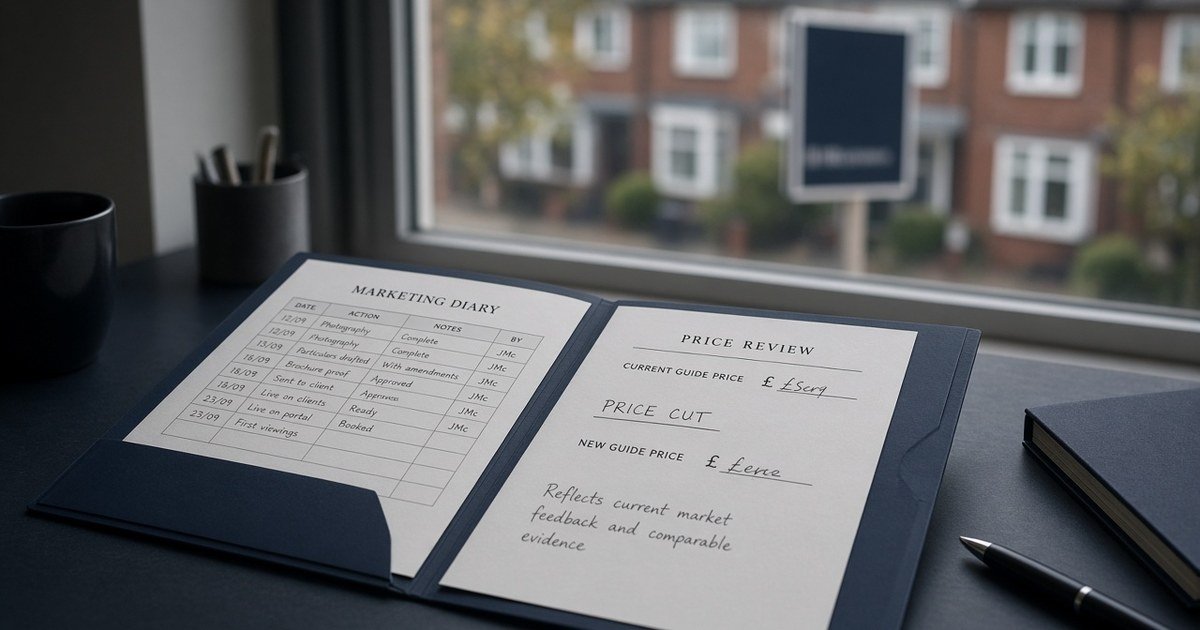
Then attach the marketing papers before the glossy brochure. Credit can read a brochure in five minutes. They cannot invent a viewing log from a covering email. Put the diary, the cut trail, viewing feedback and residual after the last cut on page one. Thursday’s sale-exit pack lists the papers. Use it.
If the security is already on the market, show why the current ask still clears against a twelve-year stock pile and a 61% national sell-through rate. If the postcode is London or the wider South East, show the local conversion story rather than the UK average. If the security is not yet listed, do not write the exit off last spring’s schedule. Use current new listings and current sold evidence.
A decision in principle still helps when the pack is tight. It is not a substitute for the zip. Brokers who want a desk view before the full underwrite can open with the one-pager and the marketing diary, then complete identity and company papers through the usual broker route.
The September rebound is real. The crowded shelf is also real. Price the file against both.
Frequently asked questions
Does a 0.7 percent Rightmove rise mean sale-led bridges clear faster?
No. The print measures new asking prices, not clearance. National sell-through sits at 61%, stock is at a twelve-year high and agreed sales are 9% below last year. Credit still wants the marketing diary and a Plan B.
Why do London and Scotland need different residual haircuts on the same UK print?
Because conversion differs. Rightmove puts Scotland at 91% of listed homes finding a buyer and London at 42%. A national 0.7% rebound does not erase that split on a sale-led residual.
How should refinance Plan B change after the September mortgage print?
Attach a live term illustration after the latest fixes. Rightmove’s average two-year fixed rate is 5.29%, up from 5.09% in August. Stress the cover and equity the term lender uses now, not the sheet from the first bridge discussion.
Are asking prices the same as Land Registry sold prices?
No. Rightmove captures first advertised figures on newly listed stock. Land Registry and the ONS measure completed sales later. Specialist packs need both, plus local days on market.
What should go in the first email on a sale-exit bridge after this print?
One page with address, title, loan, term, ask, cuts, days on market, agent, conveyancer, status and Plan B, then the marketing diary and residual. Use the DIP engine when the pack is ready, not before the evidence exists.