The DIP priced a light conversion. The exit note said HMO or two flats. Then the Charges Register named a 1938 covenant that barred more than one dwelling, or barred trade, or barred any building beyond the existing footprint. Credit does not stall on the monthly rate first. It stalls because the bridging loan pack treated a private deed restriction as a solicitor footnote while the business plan still needed works the wording may forbid.
StatusKWO prices short commercial facilities for professional buyers, landlords and SPVs. Owner-occupier main-home lending is not the book. Current card pricing shows a monthly rate from 1.25%, an entry fee of 2%, an exit fee of 1.5%, LTV up to 85%, loans from £10,000 to £10,000,000+ and terms up to 16 months. Those figures do not rewrite a covenant that blocks the exit.
The covenant line that stalls a conversion exit after DIP
A clean decision in principle on LTV is thin if the title still carries a use limit the exit ignores. Brokers who paste “title clean” into the covering email while the Charges Register shows a notice of restrictive covenants force a second question list that should have been page one.
Our auction legal pack note already asks for title papers and special conditions. The pack you are reading is narrower. It is the restrictive covenant evidence a specialist desk wants before it funds an unregulated commercial bridge where private deed wording can block works, change of use or a refinance sale.
Start with one page. Address and title number. Gross and net loan. Term. Named exit. Then quote the covenant wording that matters, not a soft line that says “old covenants exist”. Credit can skim a brochure. It cannot invent a consent trail from a tick box.
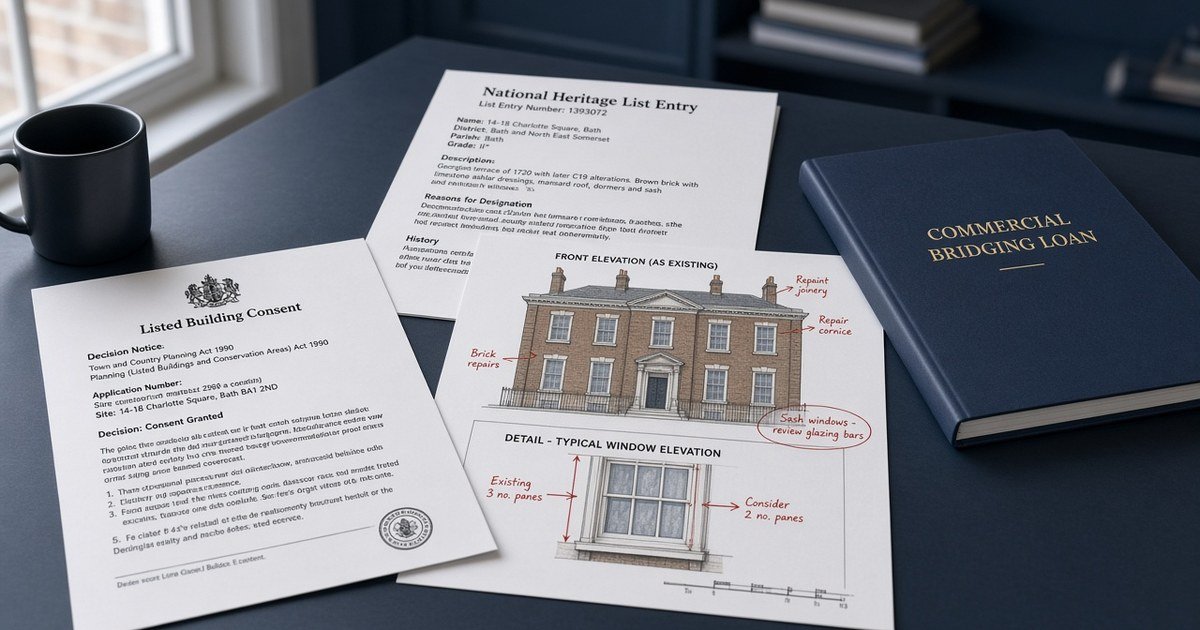
Planning permission does not cancel a private covenant. Our planning decision notice pack covers the public consent trail. Listed building consent is a different ask again. Our listed building consent pack covers heritage papers. A freehold restrictive covenant sits beside both. Public consent and private deed risk are not substitutes.
Auction finance clocks make the gap worse. Twenty-eight days do not stretch while someone hunts the imposing deed or prices indemnity after the hammer. Read the Charges Register before you bid if the catalogue hints at conversion potential. Soft catalogue copy that says “potential to convert” is not a covenant clearance.
What official copies and the imposing deed must show
Credit wants the register and the deed, not a broker paraphrase.
Order official copies of the register and title plan for the security title. Highlight every Charges Register entry that refers to covenants, deeds of covenant, transfers with restrictive covenants or notices protecting third-party interests. Soft screenshots of a portal summary fail when the lender’s solicitor asks for the sealed official copy.
Then get the imposing instrument. Many Charges Register lines only cross-refer to a 1920s conveyance, a 1960s transfer or a later deed of covenant. Without that document, nobody can read the actual words. “Subject to covenants in a deed dated…” is a pointer, not the restriction itself. Put the PDF of the deed next to the register extract. Mark the clause that bites the exit.
If the benefit land is unclear, say so early. Old covenants often leave the benefiting titles hard to map. That uncertainty drives indemnity underwriting and section 84 strategy later. Do not wait for credit to ask who could enforce.
Unregistered land still appears on some auction and probate files. Where the title is not yet registered, land charges and paper deeds do the same job. Say whether registration is part of the completion plan. A bridge that funds first registration still needs the covenant trail in the zip before drawdown.
Portfolio finance books need a per-title covenant map when one SPV borrows across several assets. Do not hide a conversion-blocked house behind nine clean buy-to-lets. Credit opens the awkward title first.
Identity, source of funds and SPV papers still sit in the general bridging pack note. Covenant papers sit beside them. They do not replace them.
Valuers will notice use and layout. If the inspection shows flats already created against a one-dwelling covenant, expect a same-day call. Send the register and deed before the valuation instruction so the valuer is not the first person to spot the conflict.
Notices versus restrictions and why lease covenants sit differently
HM Land Registry’s Practice guide 19 draws a clean line. A notice records the burden of an interest affecting a registered estate. A restriction regulates how dispositions get onto the register. Freehold restrictive covenants are usually protected by notice in the Charges Register. The entry does not prove the covenant is valid. It protects priority if the interest is valid.
That distinction matters for credit. A notice of covenants is a red flag to read the deed. It is not automatic proof that an injunction would succeed tomorrow. It is also not permission to ignore the wording because the entry looks old.
GOV.UK’s short HM Land Registry restrictions page points brokers to Practice guide 19 and related guides when a restriction blocks registration of a charge or transfer. Do not confuse a restriction that needs landlord consent to register a disposition with a freehold use covenant that limits how the land may be used. Both can stall a file. They need different papers.
Leasehold stock adds another trap. Practice guide 19 explains that certain lessor and lessee restrictive covenants that relate only to the demised premises cannot be protected by notice in the same way. Our leasehold and ground rent pack covers term, rent and consent to charge. If the lease itself bans the intended use or works, put that clause next to the freehold covenant extract. Do not let a freehold “clean” line paper over a lease ban.
Positive covenants are different again. A positive covenant demands that someone do something or spend money. The Upper Tribunal route discussed later does not discharge positive covenants. If the deed mixes positive and restrictive wording, mark each type. Credit prices the restrictive use risk and the positive cost risk as separate questions.
Auction special conditions often push title risk to the buyer. If the conditions say the buyer takes subject to whatever appears on the register, say that before you ask for conversion pricing. Hope is not an underwriting paper.
When indemnity insurance helps and when works kill the cover
Legal indemnity for restrictive covenants is a tool. It is not a magic wand.
Insurers commonly price cover where the beneficiary is hard to find, the covenant is old and the risk is historic breach rather than a live dispute. A policy schedule that names the lender as an insured party can clear a refinance or sale where the use already matches the surrounding street and nobody plans works. Attach the schedule, the limit of indemnity and any lender endorsement. A broker email that says “indemnity available” without a quote fails.
Works change the underwriting. Many residential restrictive-covenant policies exclude development, redevelopment or change of use. They also fail if the parties already know of an objection or dispute. If the exit needs a loft conversion, an extension, a new dwelling or a commercial use the deed forbids, read the exclusions before you treat indemnity as Plan A. A policy that only covers the as-built house does not fund a conversion story.
Known breach with active correspondence is worse. Once someone with the benefit has written in, indemnity markets often close. Put any neighbour letters, solicitor correspondence or court papers in the zip on day one. Hiding a live dispute until after valuation wastes the auction clock.
Indemnity also fails as a substitute for planning. A policy does not grant planning permission. It does not discharge a planning condition. It does not replace HMO licensing evidence where the exit is a multi-let. Keep public and private trails separate in the pack.
For development finance or heavy works bridges, expect credit to ask whether indemnity is even on the table. Many desks will not price a works facility on indemnity alone when the covenant bites the scheme. Either redesign the works, seek a deed of release, or show a credible section 84 path with time and cost. Soft talk about “insurance later” after first draw fails.
Sale exits still need a diary and Plan B. Our sale-exit pack already asks for that. Add the covenant and indemnity position next to the diary so a buyer’s solicitor does not discover the Charges Register line three weeks before exchange.
Section 84 trails planning clash and how credit prices delay
Section 84 of the Law of Property Act 1925 lets the Upper Tribunal (Lands Chamber) discharge or modify restrictive covenants in defined cases. GOV.UK’s guide for applications to discharge or modify restrictive covenants (T608) is blunt. The owner of freehold or leasehold land subject to a restrictive covenant may apply. The Tribunal has no power to discharge or modify positive covenants or easements such as a right of way.
Credit does not need a law essay. It needs the trail and the clock.
If the exit depends on discharge or modification, show the draft grounds, the imposing deed extract, the title plan and any planning permission that supports the reasonable use argument. Say whether an application has been filed, is only contemplated or has already been refused. A covering line that says “we can go to the Lands Chamber” without papers and a timeline fails.
Tribunal work takes months, not days. A three-month bridge that assumes a contested section 84 win inside the term is usually the wrong product shape. Stretch the term only when residual and interest make sense, or keep a Plan B exit that works even if the covenant stays. Do not use the bridge as a bet on tribunal timing.
Planning clash is common. A planning permission for two dwellings does not erase a one-dwelling covenant. Neighbours who missed the planning process can still hold the benefit of a private restriction. Credit wants both papers side by side. If planning was refused for the same scheme the covenant blocks, say so. That fact cuts both ways on section 84 strategy and on sale pricing.
Compensation risk sits in section 84 too. The Tribunal can attach payment to a discharge or modification. Budget for it if the statement of case leans that way. A works cost plan that ignores possible compensation understates the cash need.
Contaminated land and ground risk remain separate. Our contaminated land Phase 1 pack covers LCRM papers. A brownfield site can carry both ground risk and old estate covenants. Send both packs. Do not let one bury the other.
What brokers should put in the first covenant zip
Brokers who send one clear zip save a day of chase. Name the files so a human can open them.
- One-page summary with title number, loan ask, exit and the covenant wording that bites that exit.
- Official copies of the register and title plan with Charges Register covenant entries highlighted.
- The imposing deed or conveyance PDF with the relevant clause marked.
- Any existing legal indemnity quote or schedule, including exclusions for works or change of use.
- Neighbour or beneficiary correspondence if any dispute or enquiry already exists.
- Planning decision notice or application papers where the exit needs works or change of use.
- Section 84 draft or filed papers only where discharge or modification is part of the plan, with a realistic timeline.
- Sale diary or refinance illustration that still works if the covenant stays.
Put the awkward title first on multi-asset files. Credit will find it anyway.
Do not invent a deed of release that has not been signed. Do not invent a beneficiary consent email. Soft verbal comfort from a neighbour is not evidence. If consent is coming, show the draft deed and the named party. If it is not coming, say the file will run on indemnity, redesign or tribunal. Price the delay.
Auction packs should include the special conditions extract that allocates title risk. Post-hammer files need the memorandum and deposit papers in the usual place. Covenant extracts still belong in the same zip so the lender’s solicitor does not chase them on day twenty.
Light refurb that stays within the existing use usually needs less covenant drama than a conversion. Say what the works are. A kitchen and bathroom refresh against a one-dwelling house is a different credit story from creating a second front door. Match the schedule of works to the covenant text line by line.
When the pack is ready, ask for terms through the decision in principle engine or send the zip through your usual broker channel. Clear covenant papers get a faster human read than a glossy brochure that hides the Charges Register.
Frequently asked questions
Does planning permission override a restrictive covenant?
No. Planning permission is a public consent. A restrictive covenant is a private deed restriction. You can hold both a permission and a covenant that still blocks the same works. Send both trails. Credit prices the private risk even when the local authority has said yes.
Will legal indemnity always clear a conversion bridge?
No. Many policies exclude development, redevelopment or change of use and fail once a dispute is known. Indemnity can help where the use already matches the street and nobody plans works. It rarely carries a conversion exit on its own. Read the exclusions before you treat a quote as Plan A.
What if the Charges Register only mentions an old deed?
Order the imposing instrument. A cross-reference without the deed leaves credit reading a pointer, not the restriction. Official copies plus the deed PDF are the baseline pack. Soft paraphrases fail when the lender’s solicitor asks for the clause that bites.
Can the Upper Tribunal fix the covenant inside a short bridge term?
Sometimes the Tribunal can discharge or modify a restrictive covenant under section 84, but the process is not a twenty-eight day auction tool. Show filed or draft papers, grounds and a realistic clock. If the term cannot absorb tribunal delay, keep a Plan B exit that works with the covenant still in place.
Do leasehold files need the same covenant pack?
Yes, with extras. Freehold notices and lease clauses are different risks. Put lease use and alienation covenants next to any freehold Charges Register entries. Landlord consent to charge still sits in the leasehold pack. Do not assume a freehold “clean” line clears a lease ban.