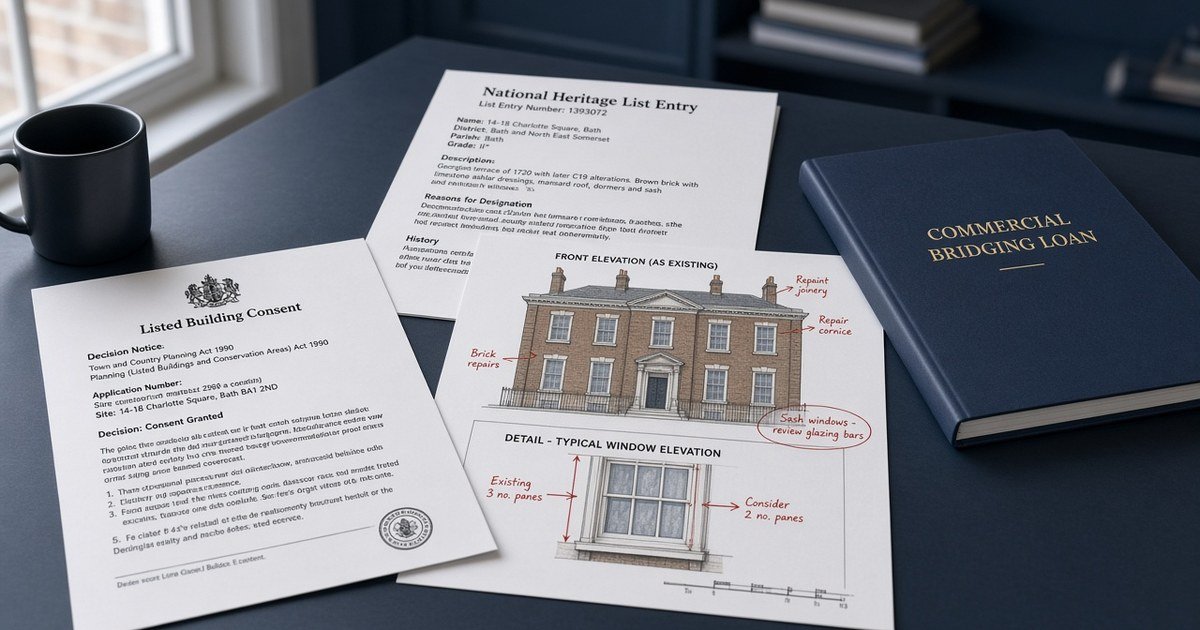
The works schedule is priced. The valuer is booked. Then credit asks for the listed building consent decision and the broker forwards a conservation-officer email that still says “application pending”. The bridging loan does not fall over on LTV. It stalls on heritage papers the desk cannot time.
StatusKWO underwrites short commercial facilities for professional landlords, investors, developers and corporate SPVs. Owner-occupier main-home lending sits outside that book. The published schedule currently shows a monthly rate from 1.25%, an entry fee of 2%, an exit fee of 1.5%, LTV up to 85%, loans from £10,000 to £10,000,000+ and terms up to 16 months. None of those figures replaces a live list entry and consent trail when the asset or the works sit inside statutory listing.
The listed works file that stalls when consent is still with conservation
A tidy decision in principle on purchase price alone is not a funded first draw. Credit needs to know whether the building is listed, what grade it carries, whether works need listed building consent, whether that consent has already been granted and whether conditions still block start on site. Our bridging pack note covers identity, companies and exits. The planning decision notice pack covers ordinary planning permission and conditions. The party wall pack covers adjoining owners. What follows is narrower. It is the listed building evidence a specialist desk wants before it funds a purchase or works facility against a listed asset.
Start with one page. Site address and title number. List entry number and grade. Whether the works touch the listed building, its interior or a curtilage structure. Consent application reference and decision date. Conditions still open. Heritage statement attached or missing. Named cash for specialist surveys and protective works. Gross and net facility. Named exit. Borrower name. Then attach the PDFs. A covering line that says “listed, conservation aware” does not underwrite a programme.
Late papers burn interest. A facility that assumes sash replacement in week three while the authority is still consulting Historic England is already soft on paper. Brokers who treat listing as a local search footnote after valuation often discover the consent clock when the contractor is already priced. Send the list entry with the first works enquiry. Pricing then stays about cost and exit.
How to prove the listing grade and what the list entry actually covers
Listing is a fact of the asset, not a broker opinion. Credit wants the official entry, not a brochure line that says “period character”.
For England the National Heritage List for England is the official register. Historic England’s Search the List service is the route most solicitors and credit teams use. Pull the list entry PDF or print that shows the name or address, list entry number, grade and description. Match the address on the title to the address on the entry. Flat numbers that drift between the lease, the catalogue and the list entry create delay.
Grades matter for consultation and risk, not for whether consent exists. Grade I means exceptional interest. Grade II* means more than special interest. Grade II means special interest. Most commercial bridging stock that is listed sits at Grade II. Say the grade on page one. Do not bury it in a solicitor footnote on day twelve.
The whole building is listed, inside and out, unless the modern entry expressly carves something out. Older descriptions can be short. They identify the building. They do not list every protected feature. Assume interiors, staircases, joinery, fireplaces and external fabric sit inside the listing until a conservation officer or heritage specialist says otherwise in writing. Curtilage structures built before 1 July 1948 can also sit inside the listing. Coach houses, boundary walls and railings often do. Works to those structures need the same consent trail as works to the main house.
Wales runs through Cadw and the Cof Cymru record rather than the English list. Scotland and Northern Ireland have their own designation systems. Say which nation the title sits in before you quote English list numbers or English decision clocks. A broker who pastes an English list entry against a Welsh title wastes a week.
Auction lots raise the same point earlier. Auction finance clocks are fixed once the hammer falls. The auction legal pack note already asks for title and special conditions. If the catalogue whispers “listed” or the local search will shout it, put the list entry in the first zip before the bid. A twenty-eight day completion does not wait for a heritage statement that should have been commissioned before the room.
Consent versus planning permission and building control on the same site
Listed building consent is not planning permission. It is not building regulations approval. Mixing those three into one “approvals” cell is how files stall twice.
Historic England’s listed building consent guidance is blunt. If you want to alter or extend a listed building in a way that affects its character as a building of special architectural or historic interest, or demolish it, you must first apply for listed building consent from the local planning authority. Unauthorised works are a criminal offence. A planning authority can insist that work carried out without consent is reversed. An owner can struggle to sell or refinance stock that still carries unauthorised heritage works.
GOV.UK’s when permission is required guidance puts listed building consent among the other regimes that can still apply even when a planning application is not needed. Building regulations, tree protections and advertisement consent sit in the same list. Credit wants each regime named separately on the one-pager. A perfect planning decision notice does not waive listed building consent. Building control sign-off does not either.
The Planning (Listed Buildings and Conservation Areas) Act 1990 sits behind the control. Section 7 of the Act makes it clear that works for demolition, alteration or extension that affect special character need authorisation. Section 16 lets the authority grant or refuse consent and attach conditions. Credit does not need a lecture on the statute. Credit needs the decision notice and the condition schedule that flows from it.
Ordinary planning permission still matters when the works also amount to development. External extensions, change of use and new structures in the curtilage often need both. Submit both decision notices. Do not ask the underwriter to infer one from the other. Higher-risk residential schemes that also touch building control under the Building Safety Act regime need the Gateway 2 pack as well. Listing does not replace that route. It sits beside it.
Light decorative works that never touch historic fabric may fall outside consent, but that call belongs to the conservation officer or a heritage specialist, not to a broker covering email. Structural openings, window replacements, roof covering changes, internal wall removals, fireplace strips and extensions almost always need a written answer. If the valuer photographs show original sash boxes and the schedule of works shows uPVC, assume consent is required until the authority says otherwise.
Heritage statements drawings and the eight-week decision clock
Consent applications are not outline. The Planning Portal listed building consent guidance note is clear that the application must give enough detail, including a plan and other drawings, for the impact on the building to be assessed. Credit wants those same papers in the facility pack.
A heritage statement that explains what is special about the building and how the works affect that special interest belongs in the first zip for any works facility. Existing and proposed elevations. Floor plans. Sections through openings. Photographs of the fabric that will change. Method statements for repairs that reuse original materials. If the authority asked for a design and access statement, attach that too. A one-paragraph broker paraphrase of “sympathetic refurb” is not a heritage statement.
Decision clocks run from a valid application. Most authorities aim for about eight weeks once the application is registered. Pre-application advice can shorten the argument later, but it is not consent. Put the validation date and the target decision date on page one. If Historic England or a local amenity society has been consulted, say so. Silence about consultation is how brokers discover a late objection after the contractor has been briefed.
Conditions arrive with the decision. Preservation of particular features. Making good after the works. Reconstruction using original materials. Phased recording before strip-out. Restricted methods for cleaning or pointing. Each condition can sit in front of first draw or in front of a later release. Map them. Do not leave the underwriter to read a six-page decision notice cold on the morning of drawdown.
Discharge evidence matters as much as the grant. A consent that still carries a pre-commencement recording condition is not a green light for scaffolding. Attach discharge letters or written confirmation that the condition is satisfied. Our build-cost and drawdown pack covers how staged releases work once the programme is live. Heritage conditions sit at the front of that sequence, not as an afterthought in month four.
Purchase bridges without works still need the list entry. Credit prices the asset knowing a future buyer or term lender will ask the same questions. If previous owners carried out works, ask whether consent was obtained. A clean looking kitchen can still be unauthorised if it ripped out listed joinery. Unauthorised works are a title and insurance problem before they are a works problem. Say what is known. Do not hope the search pack is silent forever.
Conditions discharge curtilage structures and unauthorised works risk
Curtilage is where listed files hide delay. Boundary walls, outbuildings and later extensions can sit inside the listing even when the list description barely mentions them. Works to demolish a coach house or open a new gateway in a listed wall need the same consent trail as works to the principal elevation. Draw the curtilage on a plan. Mark which structures the borrower intends to touch. Credit will not invent the boundary from a marketing photograph.
Leasehold listed stock adds freeholder consent on top. A headlease can block alterations even when the local authority has granted listed building consent. Put the freeholder licence position next to the consent decision. Mixing the two into one “landlord fine with it” line hides which paper is missing. Ground rent and service charge evidence still follows the usual leasehold pack path. Listing does not replace that pack either.
Unauthorised works kill exits. Historic England warns that planning authorities can require reversal and that owners can struggle to sell. A refinance or sale exit that assumes a term lender will ignore missing consent is not an exit. Put any known enforcement correspondence in the first zip. If the borrower intends to regularise works already done, show the retrospective application and the programme risk. Do not price a twelve-month bridge on a regularisation that the authority has already refused once.
Insurance follows the same honesty test. Buildings cover for listed stock can carry repair-method conditions and higher reinstatement figures. Our buildings insurance evidence note covers the schedule and sum insured. Tell the insurer the grade and the consented works. A certificate that still treats the asset as a standard terrace while the list entry shows Grade II* will not survive the next credit review.
Development-heavy programmes may belong on development finance rather than on a short bridge. Heavy strip-out, structural alteration and phased heritage recording often need staged monitoring that a pure purchase bridge was never built to run. Say which product the file actually is. A bridge that pretends to be a full listed conversion programme usually returns for a restructure when the first condition bites.
How listing delay hits purchase clocks sale exits and refinance
Interest accrues while conservation replies. An auction buyer who discovers listing detail after the hammer is already inside a fixed completion date. Private treaty buyers who exchange before consent is granted take programme risk into the completion statement. Put the consent status next to the completion date on page one. Hope is not a float.
Sale exits need buyer solicitors who will accept the consent trail. Missing decision notices, undischarged conditions and unexplained alterations all slow a sale. Our sale exit evidence note covers the papers a desk wants when the exit is a disposal. Add the list entry and consent pack to that pile when the asset is listed. A soft house-price print makes fussy buyers fussier. Papers still clear first.
Refinance exits face term-lender credit committees that ask the same heritage questions again. A bridge that funded works without consent can leave the borrower with a prettier asset and a blocked refinance. Keep the consent and discharge letters with the valuation and the EPC. Do not assume a term lender will “take a view” on Grade II fabric that changed without authority.
Portfolio and cross-charge files multiply the problem. One listed asset inside a multi-asset package can slow the whole facility if its consent trail is thin. Portfolio finance underwriting still wants asset-level honesty. Flag the listed titles on the schedule. Do not bury one Grade I coach house inside twenty ordinary flats and hope nobody opens the list.
Broker packaging speed is still a credit advantage. Files that arrive with the list entry, decision notice, heritage statement, drawings and condition map get priced. Files that arrive with “conservation dealing” in the subject line wait. If you need a quick steer before a full application, use the decision in principle engine with the list entry attached. Do not send the works cost alone and promise heritage papers later.
What brokers should put in the first listed-building zip
Send one zip. Name it with the site address and “listed-building pack”. Keep the one-pager on top.
- One-pager with address, title number, list entry number, grade, works summary, consent status, open conditions, facility size, exit and borrower.
- Official list entry print or PDF from Search the List or the equivalent national record.
- Listed building consent decision notice or the validated application pack if the decision is still outstanding.
- Heritage statement plus existing and proposed drawings and key photographs.
- Condition schedule with discharge letters or a clear note of what remains open.
- Planning decision notices where the works also need ordinary planning permission.
- Curtilage plan marking outbuildings, walls and structures the works will touch.
- Freeholder licence position on leasehold stock.
- Any enforcement or regularisation correspondence for past works.
- Buildings insurance schedule that reflects listed reinstatement and the consented programme.
If the lot is an auction purchase, add the memorandum, deposit trail and special conditions beside this pack. If adjoining works also cut a party wall, add the party wall notices and award. If the scheme is a heavier build, add the build-cost and drawdown papers and say whether the file should sit on development finance instead.
Brokers who want a named contact for packaging can start on the brokers page. The desk still prices from documents. A warm introduction does not replace a missing decision notice.
Frequently asked questions
Does every listed property need listed building consent before a bridge can fund?
No. A purchase bridge against a listed asset can still fund when no works are proposed, provided the list entry is in the pack and any past works have a clean consent story. Works that affect special character need consent before the desk will treat the programme as fundable. Credit decides that from the papers, not from a brochure.
Is listed building consent the same as planning permission?
No. They are separate regimes. Some works need both. Some need listed building consent even when ordinary planning permission is not required. Put both decision notices in the pack when both apply. Do not ask credit to infer one from the other.
What if the consent decision is still pending when we want to draw?
Say so on page one with the validation date and the target decision date. Many desks will not release works money until the grant is in hand and pre-commencement conditions are clear. Purchase money against a clear title can still be a different conversation. Do not blur the two draws.
Do curtilage buildings and boundary walls need their own consent trail?
Often yes. Structures within the curtilage that formed part of the land before 1 July 1948 can sit inside the listing. Demolition or alteration of those structures needs the same honesty as works to the principal building. Draw them. Do not leave them as background in a site photograph.
Can StatusKWO fund listed stock for a consumer homeowner?
No. StatusKWO prices unregulated commercial facilities for professional and corporate borrowers. Main-home owner-occupier lending sits outside that book. Professional investors and SPVs buying or working listed investment stock are the audience for this pack.