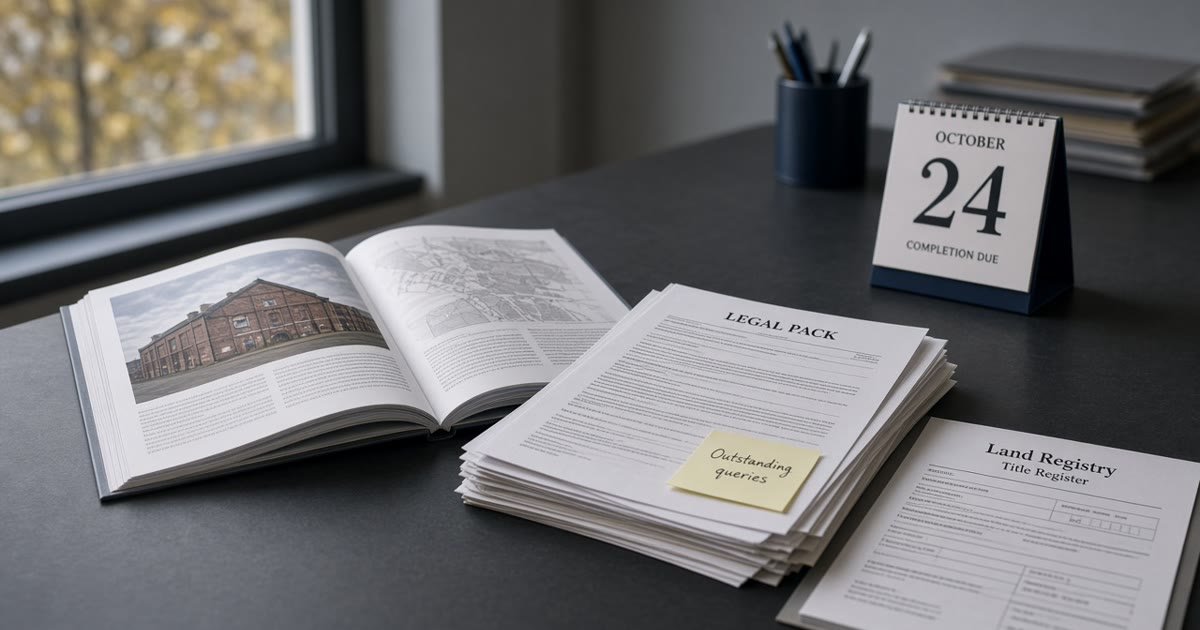
The hammer has already fallen. The covering email says finance is lined up. Then credit opens the zip and finds an out-of-date title print, three special-condition pages the broker never summarised and a deposit trail that stops at a round-sum inward transfer. The auction finance clock does not pause while someone rewrites the pack. The facility stalls on papers that should have been in the first email.
StatusKWO prices short commercial facilities for professional and corporate property buyers only. The published schedule currently shows a monthly rate from 1.25%, an entry fee of 2%, an exit fee of 1.5%, LTV up to 85%, loans from £10,000 to £10,000,000+ and terms up to 16 months. Those figures sit on the product sheet. They are not a promise that every 28-day lot prices at the floor.
The legal pack gap that stalls an auction DIP
A tidy decision in principle request is not a funded completion. Credit needs the same documents the buyer’s solicitor should have read before the bid. Catalogue photos do not underwrite title. A broker summary of special conditions does not replace the PDF.
Our general bridging pack note covers identity, companies and exits. The 28-day auction timeline covers the calendar. This page is narrower. It is the legal pack evidence a specialist desk wants before it prices an unconditional lot with a fixed completion date.
Start the enquiry with one page. Lot number. Auction house. Sale date. Guide and reserve if known. Hammer price or intended bid. Gross and net loan. Deposit already paid or to be paid. Completion date written into the special conditions. Borrower name and company number. Named exit. Then attach the legal pack before the floor plan. Credit can read a brochure in five minutes. They cannot invent a restriction from a covering email.
Unconditional traditional auctions bind the buyer when the hammer falls. Modern Method of Auction and conditional lots behave differently. Read the conditional versus unconditional split before you treat every catalogue as a 28-day bridge. The pack below assumes an unconditional England and Wales lot where exchange happens in the room and completion is fixed.
A soft market does not extend that date. Completions across specialist books were quieter in Q2. Our BDLA Q2 note recorded the association’s fall in member completions and the sharper drop in applications. Quieter private treaty exits make auction clocks more, not less, unforgiving. The legal pack has to clear first time.
Title plan charges and filed documents credit must see
Bridging is asset-led. The security has to be identifiable, chargeable and worth the loan after costs. Begin with the address, tenure and a current title register and title plan. GOV.UK’s public Land Registry search explains how buyers obtain register and plan copies. Credit still wants those documents in the pack, not a promise that someone will download them later.
Match the lot address to the title number. Flat numbers that drift between the catalogue, the register and the charge plan create legal delay. If two titles sit behind one brochure photograph, draw it. Do not leave the underwriter to invent a single freehold from two leases.
Existing charges must be listed with approximate balances. First-charge bridging against a clear title is one file. A second charge or a cross-charge over other assets is a different file. Do not hide a prior charge because it makes the LTV look cleaner. Credit will find it on the register and then distrust the rest of the pack.
Restrictions, notices and cautions belong on page one of the solicitor note. A restriction that blocks a charge without a third-party consent is a completion risk inside twenty-eight days. A caution that needs lifting before registration is the same. If the pack only ships a title summary and marks deeds as “filed”, order the filed documents early. Waiting until day twelve to request a lease or transfer wastes the week the valuer and lender solicitor need.
Leasehold needs the remaining term, ground rent, service charge position and any consent-to-charge clause. A short lease that a term lender will not refinance is an exit problem, not trivia. Put the lease PDF in the first zip. A covering line that says “long leasehold” is not enough when the register shows sixty-eight years remaining.
Unregistered land and first registration after completion need an explicit plan. Auction lots still land with paper title. Credit can work with that when the solicitor has already mapped the registration path. Surprise first registration on day twenty is how files miss the date. See what happens if you win and cannot complete for the commercial cost of a failed clock. Prevention is cheaper.
Special conditions that rewrite the Common Auction Conditions
Most England and Wales catalogues sit under auction conduct and sale conditions that follow the RICS Common Auction Conditions framework. RICS’s good practice note on real estate auctions is blunt about the split. Auction conduct conditions govern the room. Sale conditions govern the contract between seller and buyer. Special conditions rewrite the general sale conditions for that lot.
Credit wants the special conditions read line by line, not paraphrased. Buyer’s premium. Seller’s legal fee contribution. Search pack reimbursement. Overage. Retention. Early completion. Interest on late completion. Named conveyancer requirements. Option to tax. Vacant possession versus subject to tenancies. Each of those lines changes either cash at completion or the security story.
A buyer’s premium that sits in the contract can push the cash the borrower must find on completion. It can also change how Stamp Duty Land Tax is calculated when the fee is treated as part of the consideration for the land. HMRC’s auction house fees example shows a hammer price plus a vendor’s auction fee forming chargeable consideration, while a separate registration fee paid for the right to bid did not. Put the premium wording and the intended SDLT basis in the pack. Do not assume the hammer price alone is the tax number.
Seller cost recoveries are easy to miss in a dark PDF. A condition that recovers the seller’s legal fees and search costs can add thousands to the completion statement. Credit prices the facility against the purchase. The borrower still has to clear those extras from cash or equity. Say the amount on page one. If the condition is open-ended, say that too.
Overage and clawback change refinance and sale exits. A future payment tied to planning or a resale can sit behind the charge and scare a term lender. If overage is present, attach the full wording and the borrower’s plan to live with it. Silence is not comfort.
Interest on late completion is not a soft admin point. Unconditional lots usually allow the seller to serve notice and keep the deposit if the buyer fails. The special conditions set the rate and the mechanics. Credit will ask whether the borrower can still clear completion if the valuation or legal replies slip by a few days. A facility sized to the last pound of available cash fails that test.
Tenancy leasehold and VAT lines that change the facility
Vacant possession and tenanted stock are different securities. The catalogue headline often blurs them. Credit will not average the two stories. They take the weaker one.
If the lot is sold with vacant possession, the pack should show how that is evidenced. Empty inspection notes. Notice periods already served. Keys. Utility account position. A “vacant” line in the brochure is marketing. A tenancy schedule that still shows an AST is underwriting.
If the lot is sold subject to tenancies, send the tenancy agreements, rent amounts, deposit protection evidence, arrears schedule and any notices already served. A portfolio rent roll pack is the model when several units sit in one lot. One unsigned AST and a verbal rent figure is not a rent roll.
Leasehold management packs stall more auction bridges than brokers expect. Ground rent demands, service charge arrears, major works notices and landlord consent clauses all sit in that pack. If the special conditions force the buyer to clear seller arrears, put the arrears figure next to the loan amount. A refinance exit onto a portfolio line will ask for the same papers later. Better to see them before the hammer.
Mixed-use and commercial lots need the Option to Tax position. If the seller has opted to tax, VAT can sit on top of the hammer price. That changes cash, SDLT analysis and sometimes the valuation basis. Put the election evidence or the solicitor’s written view in the first pack. Guessing after exchange is how professional buyers burn equity they meant to keep for works.
HMO or multi-let auction stock brings licensing risk into the same zip. Our HMO licensing evidence note covers the council papers. If the catalogue implies five rooms and shared amenities, attach the licence position before credit prices a multi-let bridge. An unlicensed shared house is not cured by a short auction completion date.
Planning and works belong beside the legal pack when they affect value or the exit. Light refurbishment needs a costed schedule. Heavier schemes may belong on development finance with staged drawdowns rather than on a sixteen-month bridge. Mixing a full rebuild programme into an auction bridge email is how files bounce between desks.
Deposit SDLT and cash that must clear before the hammer
Auction finance fails on cash as often as it fails on title. The deposit is usually ten percent of the hammer price and is due immediately. Proof of cleared funds for that deposit belongs in the first enquiry if the bid has not yet been placed. After the hammer, the trail must show the money left the borrower’s account and arrived where the auction conditions require.
Source of funds still applies. A round-sum inward payment with no origin note is not a trail. If the deposit came from a prior sale, attach the completion statement. If it came from a director loan, attach the loan account or board minute and the director’s statements. Overseas funds add time. Say so on page one rather than hoping it is ignored.
Balance of purchase price, buyer’s premium, seller cost recoveries, SDLT and the borrower’s own legal fees all need a cash plan. Bridging can fund the purchase price against the security. It does not invent cash for tax and fees the borrower forgot to model. Put a simple completion cash waterfall in the pack. Hammer. Premium. Recoveries. SDLT. Legal fees. Net loan. Equity in. Shortfall or surplus.
SDLT timing is separate from the bridging drawdown. The return and payment sit with HMRC after completion under the usual rules. The borrower’s solicitor still needs the cash available. Misreading a buyer’s premium as outside consideration is a common error on auction files. Use the HMRC auction fees example as the starting point and let the solicitor confirm the live lot.
Retained or rolled-up interest changes net proceeds. StatusKWO’s published rates are schedule figures only. A facility that looks large enough on gross loan can leave the borrower short once fees and retained interest sit in the statement. Show the net figure on page one. Credit will recalculate it anyway.
Exit evidence that fits a fixed completion date
The exit is the loan. Auction files often treat the exit as something to invent after the keys arrive. That is backwards. The completion date is fixed. The exit has to be written before the bid if the bridge is meant to clear inside the published term.
A sale exit after a light refurbishment needs a realistic works window, a marketing period and a price that survives soft buyer demand. Quieter transaction prints do not kill every sale-led file. They do kill files that assume last year’s asking price and a four-week exchange. Put agent evidence and a costed works schedule in the pack.
A refinance exit needs a named product type and a reason a term lender will take the asset at the end of the bridge. An agreement in principle is useful when it is current and matches the same security and borrower. An AIP addressed to a different SPV, or based on a value the bridging valuer will not support, is decoration. If refinance pricing has moved since the catalogue was printed, update the number before you ask credit to stretch LTV.
A cash exit from another sale, probate or a business receipt needs documents, not optimism. Grant of probate, solicitor correspondence and a dated completion statement beat a verbal “funds are coming”. Auction clocks do not wait for estate administration that has not started.
Cross-collateral exits need the other titles in the first pack. A bridging loan that relies on a second charge over an existing asset still needs valuation and legal capacity on that asset. Do not introduce a cross-charge on day eighteen because the auction lot alone will not clear the advance.
Plan B belongs in writing. Sale if refinance shortens. Refinance if the sale stalls. Additional equity if both slip. Credit will ask the question. Answer it before the valuation instruction goes out.
What brokers should send with the first enquiry
Send one zip. Name the files so a human can open them without decoding “scan7”.
One-page deal summary. Auction catalogue extract. Full legal pack as supplied by the seller’s solicitor. Buyer solicitor’s written review note if it already exists. Special conditions highlighted for premium, fees, overage, tenancies and completion date. Title register and plan. Lease and management pack where relevant. Tenancy schedule and ASTs where relevant. Deposit source of funds. Completion cash waterfall. Proposed exit with dates. Borrower KYC and company papers. Any existing AIP or term quote for the refinance exit.
If the solicitor review is not ready, say when it will be. Do not claim the pack is “clean” without a named reviewer. Credit would rather wait twenty-four hours for a real note than price on a brochure.
Instruct the auction-experienced solicitor before the sale when you can. The packaging guide still applies. Auction files simply compress every step. Identity, source of funds and the legal pack have to move in parallel with the valuation, not in series after the hammer.
When the lot is still pre-auction, ask for a DIP against the guide and a stated maximum bid. Credit can revise to the hammer price after the sale. Waiting until the room is done to start KYC is how twenty-eight days become nineteen.
If the lot is live and the legal pack is already in hand, send the zip with the one-page summary and request a decision in principle the same day. An incomplete pack comes back as questions. A complete pack comes back as a priced facility the solicitor can work to.
Frequently asked questions
Does a specialist lender accept the auction house legal pack without a solicitor review?
No. The seller’s pack is the starting evidence. Credit still expects the buyer’s solicitor to review title, searches, special conditions and tenancy papers and to raise issues before funds are released. A download link alone is not a certificate of title.
Can finance complete inside twenty-eight days if the legal pack arrives late?
Only if the missing papers are minor and the solicitor, valuer and lender can still clear their work. Material gaps on title, restrictions, leasehold arrears or special-condition costs usually burn days the clock does not have. Bring a complete pack before the bid when the lot is unconditional.
Do buyer’s premiums and seller fee recoveries sit inside the bridging loan?
Sometimes the facility can cover part of the purchase stack. Often those extras sit in cash the borrower must clear on completion. Put every contractual extra in the cash waterfall on page one so net loan and equity in are honest before anyone bids.
How do special conditions interact with RICS Common Auction Conditions?
Common Auction Conditions set the general framework many auctioneers use. Special conditions for the lot can change fees, completion mechanics, tenancies and cost recoveries. Credit prices the special conditions that apply to the live lot, not a generic catalogue summary.
What should brokers attach for a tenanted or HMO auction lot?
Attach the tenancy schedule, agreements, deposit protection evidence, arrears and, for shared houses, the licensing papers set out in the HMO evidence note. Vacant possession claims that conflict with live ASTs will stall the file.