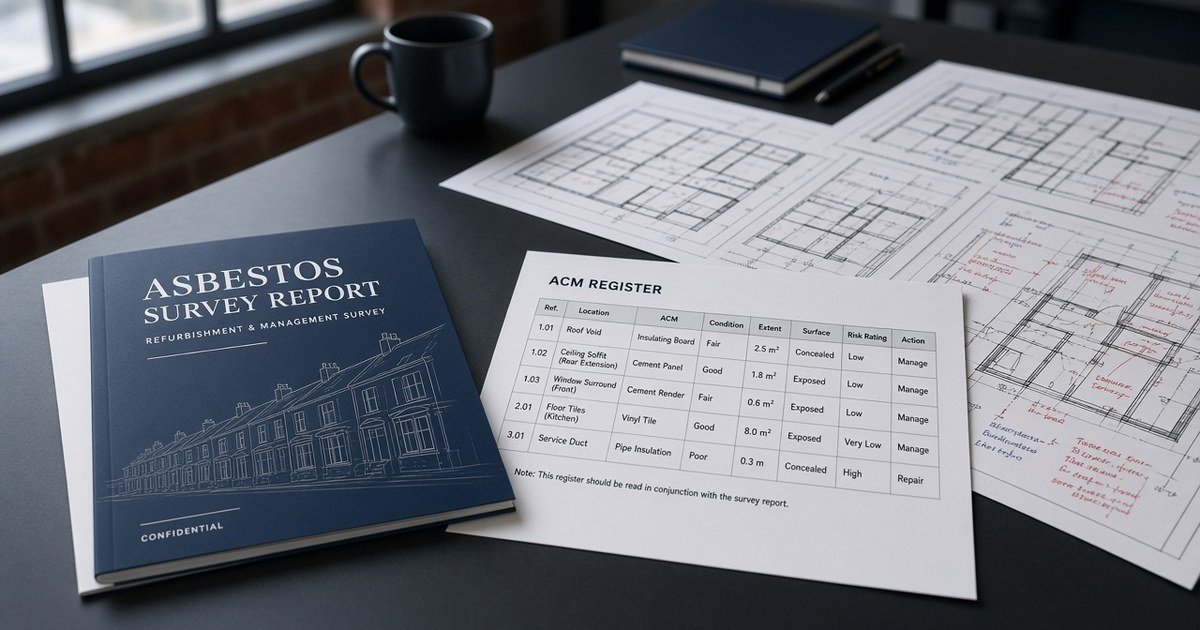
The cost plan is tidy. The contractor is booked for Monday. Then credit asks for the asbestos survey and the broker forwards a five-year-old management survey that never opened the risers the strip-out will hit. The bridging loan does not fail on headline LTV. It stalls on the wrong survey type for the works.
StatusKWO prices short commercial facilities for professional landlords, investors, developers and corporate SPVs. Owner-occupier main-home borrowing sits outside that book. The published schedule currently shows a monthly rate from 1.25%, an entry fee of 2%, an exit fee of 1.5%, LTV up to 85%, loans from £10,000 to £10,000,000+ and terms up to 16 months. None of those figures replaces a live survey that matches the programme when the fabric may hold asbestos-containing materials.
The works file that stalls when the survey is still a management survey only
A clean decision in principle on purchase price alone is not a funded first draw on a strip-out. Credit needs to know the building age, whether a duty to manage applies, which survey type sits in the pack, what the register shows, what removal is priced and who will do it. Our bridging pack note covers identity, companies and exits. The contaminated land Phase 1 pack covers soil and ground risk. The flood and environmental search pack covers flood and drainage papers. What follows is narrower. It is the asbestos survey evidence a specialist desk wants before it funds a purchase or works facility against older stock.
Start with one page. Site address and title number. Approximate build year. Whether the asset is non-domestic, a common part of multi-occupied stock or a pure domestic house. Survey type and survey date. Surveyor name and competence note. ACM locations that the works will touch. Removal cost and contingency. Named licensed contractor if removal is in the first phase. Gross and net facility. Named exit. Borrower name. Then attach the PDFs. A covering line that says “asbestos aware” does not underwrite a programme.
Wrong survey type burns interest. A facility that assumes kitchen and bathroom strip in week two while the only paper in the file is a walk-round management survey is already soft. Brokers who treat asbestos as a building-control footnote after valuation often discover the gap when the skip is on site. Send the right survey with the first works enquiry. Pricing then stays about cost and exit.
Dutyholder rules and which buildings sit inside the duty to manage
Asbestos evidence is not a broker opinion. Credit wants the papers a dutyholder would keep under the Control of Asbestos Regulations 2012, not a brochure claim that the property “looks clear”.
The Health and Safety Executive’s duty to manage overview is clear on who sits in the duty. The dutyholder can be the building owner, the landlord or the person or organisation with clear responsibility for maintenance or repair. The duty covers non-domestic premises such as shops, offices and warehouses. It also covers the common parts of multi-occupancy domestic premises, including purpose-built flats. Stairwells, plant rooms, shared roofs and risers sit inside that common-parts net even when individual flats are private homes.
The dutyholder must assess whether asbestos-containing materials are present, presume materials contain asbestos unless there is strong evidence they do not, keep a register of location and condition, assess exposure risk, write and run a management plan, monitor condition and give information to anyone who may disturb the materials. Credit does not need a lecture on the statute. Credit needs the register, the plan and the survey that underpins both.
Pure private houses used only as dwellings sit outside the statutory duty to manage. Purchase bridges against a vacant terrace still attract survey asks when works will disturb fabric built before the late 1990s. Most UK commercial stock and a large share of converted HMOs and flats still carry ACM risk in ceiling tiles, pipe insulation, floor tiles, textured coatings, soffits and cement sheets. Say the build period on page one. Do not hope a 1960s warehouse “looks modern enough” after a paint job.
Portfolio finance files multiply the dutyholder question. One asset with common parts and a thin register can slow a multi-asset package. Flag non-domestic titles and shared cores on the schedule. Do not bury one plant room inside twenty clean flats and hope nobody opens the HSE page.
Auction lots raise the same point early. Auction finance clocks are fixed once the hammer falls. The auction legal pack note already asks for title and special conditions. If the catalogue whispers “former commercial” or the photographs show old plant rooms, put the asbestos position in the first zip before the bid. A twenty-eight day completion does not wait for a survey that should have been instructed before the room.
Management survey versus refurbishment or demolition survey
Survey type is where most packs fall over. The HSE page on arranging an asbestos survey sets out two live survey types. A management survey supports normal occupation and maintenance. A refurbishment or demolition survey is required before work that disturbs fabric, major refurbishment or demolition. Mixing those two into one “asbestos survey done” cell is how files stall twice.
A management survey locates, as far as reasonably practicable, suspect ACMs that could be damaged or disturbed during normal use and foreseeable maintenance. It helps the dutyholder build a register and a management plan. It can include limited intrusive work. It is not designed to find every ACM hidden behind walls the strip-out will open. HSE guidance in HSG264 Asbestos the survey guide is blunt on that point. Credit will not treat a management survey as clearance for a full gut.
A refurbishment or demolition survey must locate ACMs, including those hidden in the fabric, before structural work starts. It is fully intrusive. Areas may need to be vacated during the survey. The surveyor should confirm the area is fit for reoccupation afterwards. Regulation 7 of the Control of Asbestos Regulations 2012 requires ACMs to be removed so far as reasonably practicable before major refurbishment or final demolition. Credit wants that survey before it treats heavy strip-out as fundable.
Name the survey type on page one. Name the areas covered. A refurbishment survey limited to the ground-floor kitchen does not clear a first-floor roof strip. Attach the scope letter. Attach the floor plans marked with sample points and presumed materials. A one-paragraph broker paraphrase of “survey clear” is not a survey.
Partial programmes still need honesty. Hotel or HMO upgrades that only touch bathrooms still need a refurbishment survey of those rooms. Larger sites often need both survey types at once. Offices under a management survey. A boiler house due for demolition under a refurbishment or demolition survey. Say which paper covers which zone. Do not ask the underwriter to invent the boundary from a marketing photograph.
Purchase bridges with no works still need a clear asbestos story on older non-domestic stock and common parts. Credit prices the asset knowing a future buyer, insurer or term lender will ask the same questions. If previous owners carried out works, ask whether a suitable survey and removal trail exists. A freshly painted plant room can still hide lagged pipework. Missing papers are a title and insurance problem before they are a works problem.
Register management plan and how condition scores hit pricing
The survey is only half the ask. Credit wants the register and the management plan that turn samples into day-to-day control.
HSE’s duty overview expects a record of location and condition, a risk assessment, a written management plan that is monitored and reviewed at least every twelve months and information passed to people who may disturb the materials. Put the register extract in the first zip for any non-domestic or common-parts file. Highlight ACMs on the works route. Condition scores that show damage or high fibre-release potential change pricing. Encapsulate, remove or leave undisturbed. Say which path the borrower has chosen and why.
Presumed ACMs count. A management survey that presumptively labels textured coating without sampling still puts that material on the register. Removal cost then follows the presumption until analysis says otherwise. Do not cut the contingency because “it might only be plaster”. Lab certificates belong next to the register when sampling has already happened.
Competence matters. Name the surveying organisation. Note UKAS accreditation or equivalent competence evidence where you hold it. A free desktop opinion from a contractor who also quotes the removal is not an independent survey. Credit will ask who wrote the register and who will open the fabric.
HMO licensing evidence sits beside asbestos papers on multi-let stock, not instead of them. Licensing proves the local authority position on occupation. It does not prove the common parts are managed for ACMs. Keep both packs. Fire risk assessments and asbestos registers often share the same plant rooms and risers. Send them together when the asset is multi-occupied.
Buildings cover follows the same honesty test. Insurers ask about known ACMs and works methods. Our buildings insurance evidence note covers the schedule and sum insured. Tell the insurer what the register shows. A certificate that treats a 1970s office as a modern clear shell while the survey maps lagging in the risers will not survive the next credit review.
Removal costs licensed contractors and contingency on first draw
Cost is where asbestos files hide delay. Removal is not a soft provisional sum you invent on drawdown morning.
Price each ACM the works will disturb. Encapsulation where the register supports it. Licensed removal where the material and the method require it. Skip hire, transit and disposal. Analytical air testing and reoccupation certificates after licensed work. Programme days while the area is sealed. Put those lines in the cost plan, not in a broker email that says “TBC after opening up”.
Our build-cost and drawdown pack covers how staged releases work once the programme is live. Asbestos removal sits at the front of that sequence on heavy strip-out. A first draw that funds decorative works while ACMs remain in the demolition path is the wrong order. Map pre-commencement removal against the monitoring surveyor’s first visit.
Licensed contractors need naming. Quote, insurance, waste carrier details and the method statement belong in the zip when removal is in phase one. Do not leave the underwriter to assume the main contractor “has a guy”. Non-licensed work still needs a clear method and competence trail. Say which tasks sit inside licensed work and which do not.
Contingency is not optional on pre-2000 fabric. Hidden ACMs appear once ceilings open. A desk that sees a thin contingency beside a management survey only will cut LTV or hold funds. Show the percentage and the cash. Show what happens if sampling upgrades a presumed material into a licensed removal. Hope is not a float.
Development finance may be the better product when strip-out, remediation and phased monitoring run longer than a short bridge was built to carry. Say which product the file actually is. A bridge that pretends to be a full ACM strip and rebuild usually returns for a restructure when the first sealed area overruns.
How missing asbestos papers hit auction clocks sale exits and refinance
Interest accrues while surveyors wait for access. An auction buyer who discovers plant-room lagging after the hammer is already inside a fixed completion date. Private treaty buyers who exchange before a refurbishment survey is instructed take programme risk into the completion statement. Put the survey status next to the completion date on page one.
Sale exits need buyer solicitors and valuers who will accept the asbestos trail. Missing surveys, undischarged removal certificates and unexplained textured coatings all slow a sale. Our sale exit evidence note covers the papers a desk wants when the exit is a disposal. Add the asbestos register and clearance certificates to that pile when the asset is older commercial or multi-let stock. Soft house-price prints make fussy buyers fussier. Papers still clear first.
Refinance exits face term-lender credit committees that ask the same questions again. A bridge that funded works without the right survey can leave the borrower with a prettier asset and a blocked refinance. Keep survey, register, waste notes and reoccupation certificates with the valuation and the EPC. Do not assume a term lender will “take a view” on a riser that was never sampled.
Vacant possession alone does not clear asbestos risk. Empty rooms still hold ACMs. Keys help access for a refurbishment survey. They do not replace it. Occupied common parts need dutyholder papers even when individual flats are let. Say who controls the shared areas and who holds the register.
Broker packaging speed is still a credit advantage. Files that arrive with the right survey type, register extract, removal quote and contingency get priced. Files that arrive with “contractor checking asbestos” in the subject line wait. If you need a quick steer before instructing the surveyor, use the decision in principle engine with build year and works summary attached. Do not send the works cost alone and promise asbestos papers later.
What brokers should put in the first asbestos zip
Send one zip. Name it with the site address and “asbestos pack”. Keep the one-pager on top.
- One-pager with address, title number, build year, dutyholder position, survey type, ACM summary on the works route, removal cost, contingency, facility size, exit and borrower.
- Full survey PDF. Management survey for occupation. Refurbishment or demolition survey for the works areas. Scope plans included.
- Asbestos register extract and current management plan for non-domestic stock and common parts.
- Lab certificates for sampled materials where held.
- Removal quote, method statement and contractor competence papers for ACMs in the first phase.
- Programme note showing removal before strip-out that would disturb those materials.
- Contingency line and what it covers if further ACMs appear on opening up.
- Buildings insurance schedule that reflects known ACMs and the consented works method.
- Any previous removal certificates, waste notes or reoccupation clearances for works already done.
- Access plan for surveyors where the asset is still occupied.
If the lot is an auction purchase, add the memorandum, deposit trail and special conditions beside this pack. If ground contamination is also live, add the Phase 1 desk study rather than hoping soil and fabric risks cancel each other out. If the scheme is a heavier build, add the build-cost and drawdown papers and say whether the file should sit on development finance instead.
Brokers who want a named contact for packaging can start on the brokers page. The desk still prices from documents. A warm introduction does not replace a missing refurbishment survey.
Frequently asked questions
Does every bridging file need an asbestos survey before funding?
No. Modern stock with a clear build date after asbestos bans and no works that disturb older fabric may need little more than a short note on age and programme. Older non-domestic assets, common parts and any works that open pre-2000 fabric usually need a survey that matches the job. Credit decides from the papers, not from a brochure.
Is a management survey enough for a full strip-out?
No. A management survey supports normal occupation and maintenance. Refurbishment or demolition work needs a refurbishment or demolition survey of the areas that will be disturbed. Put the right survey in the pack before you ask for first draw on heavy works.
What if the survey is still being instructed when we want to exchange?
Say so on page one. Credit may still price a purchase bridge with a condition that the correct survey lands before works drawdown. It will not pretend a management survey clears a gut. Auction clocks leave less room. Instruct the survey before the bid when the catalogue points to older commercial fabric.
Do pure residential houses fall under the duty to manage?
The statutory duty to manage targets non-domestic premises and the common parts of multi-occupied domestic buildings. A vacant private house can still need a suitable survey before works if the fabric may hold ACMs. Do not skip the ask because the title is freehold residential.
How do removal costs affect LTV and drawdown?
Priced removal and a real contingency protect net LTV and keep staged draws honest. Unpriced ACMs usually mean retained funds, a lower advance or a pause until quotes land. Put the numbers in the cost plan with the survey, not after the contractor opens the ceiling.